Revolutionary Radiant Safety: Goodbye to Leaded Aprons in Dental Radiographs
In the world of modern dentistry, the patient safety is a top priority. For this very reason, it is important to stay up-to-date with the latest scientific guidelines, which sometimes overturn old habits in favor of more effective, evidence-based choices. One of the most surprising novelties for pat
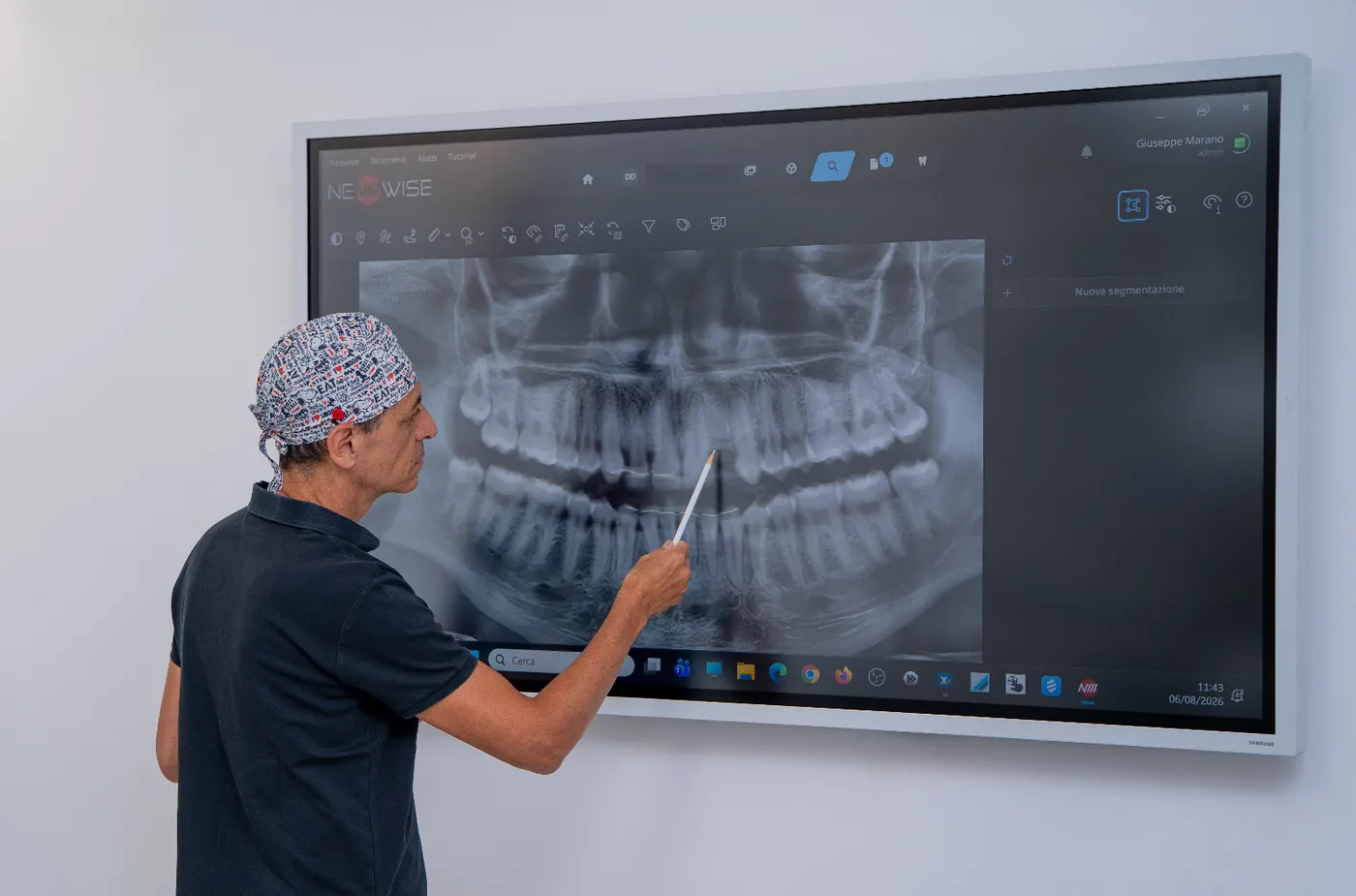
In the world of modern dentistry, the patient safety is a top priority. For this very reason, it is important to stay up-to-date with the latest scientific guidelines, which sometimes overturn old habits in favor of more effective, evidence-based choices.
One of the most surprising novelties for patients involves a gesture that many had been accustomed to for years: wearing a leaded apron or collar during dental x-rays. Well, the most influential international scientific societies-such as theAmerican Dental Association (ADA) and the Italian Society of Medical Radiology (SIRM) – today no longer recommend the use of these guards routinely.
But beware: this is not a step backward in protection, far from it. It is a progress based on safer and more sophisticated technologies that reduce X-ray doses to almost negligible levels. In this article we explain why this choice protects you and your family even better, and what it means in daily practice at our Marano Dental Experience.
Change: what the new guidelines say
Until a few years ago, it was customary to wear a leaded apron over the chest and a collar around the neck before an X-ray. This was a precautionary measure to protect sensitive organs-such as the thyroid gland and gonads-from any leaked radiation.
However, thanks to the evolution of radiographic technologies, things have changed dramatically. L’American Dental Association published new recommendations in 2024 that clearly state: the use of aprons and leaded collars is no longer necessary in most dental cases.
In parallel, in Italy, the SIRM, l’AIFM (Italian Association of Medical Physics) and theAIRP (Italian Radiation Protection Association) have signed an inter-society document that moves in the same direction: radiological protection should no longer automatically include the use of external shielding.
Why eliminating the apron is safer?
It sounds counterintuitive, doesn’t it? But eliminating aprons and leaded collars is a more effective protective measure today, for at least five basic reasons:
1. Radiation is already minimal
Thanks to the digital radiology, the X-ray doses used today are significantly lower than those of just a few years ago. The exposure during an intraoral X-ray is so low that it is often comparable to that of an airplane flight or a day in the sun.
In other words, the apron does not protect against a real danger, because the dose is already so low that it poses no health risk.
2. Apron can cause problems
It may sound incredible, but the use of physical shielding can hinder the correct acquisition of the image. A thyroid collar, if misplaced, can cover part of the area to be examined, forcing the dentist to repeat the examination-thus increasing the total exposure dose.
In addition, in automated digital radiographic systems, lead can interfere with sensors, leading the machine to increase the dose to compensate for absorption, with the paradoxical effect of exposing the patient to more radiation.
3. Shielding does not protect against internal radiation
Radiation affecting organs far from the mouth does not come from outside, but from inside, by secondary scattering. The apron is not effective against this kind of exposure, which in any case – let us remember – is infinitesimal with modern digital instruments.
4. Artifacts on images worsen the diagnosis
In some examinations such as panoramic radiographs or the CBCT (Cone Beam CT), the presence of lead can cause shadows and distortions in the image. This compromises the diagnostic quality and, again, may make it necessary to repeat the examination.
5. More hygiene and comfort
Aprons and collars are reusable, which is why they need to be sanitized carefully. Disposing of them also means removing a possible vehicle for contamination, as well as improving patient comfort, especially for those who experience discomfort or claustrophobia during the examination.
What about the children? What about pregnant women?
Two categories always deserve special attention: toddlers and mothers-to-be.
Children
Children’s thyroid is indeed more sensitive to radiation, but scientific data show that the doses used today are so low that they no longer justify the systematic use of the leaded collar. Indeed, it may be that it interferes with the examination and necessitates re-exposure.
However, in specific cases, such as some orthodontic radiographs (e.g., teleradiographs), our team may decide, if technically possible, to use the thyroid collar. The decision will always be communicated and explained to the parents.
Pregnancy
Pregnant patients often fear that an X-ray may harm the baby. But studies show that the doses absorbed by the uterus during a dental X-ray are negligible, and there is no evidence of harm to the fetus.
Therefore, even in pregnancy, the use of the lead apron is not necessary., if the examination is clinically justified.
Of course, in our practice we avoid taking X-rays during pregnancy unless strictly necessary, but in case of urgency we can proceed safely, with specific protocols and full transparency.
What changes for patients?
Specifically, when from Marano Dental Experience We will perform a dental x-ray:
-
We will no longer automatically use aprons and leaded collars
-
The radiation dose will be even lower thanks to our technology
-
The image will be sharper and without risk of repetition
-
The duration of the examination will be shorter
-
Your safety will be fully guaranteed
The technologies we use to protect you
All this is possible because we have invested with conviction in digital radiological technologies and continuous professional development. In our practice we use:
✅ Low-dose digital radiography
✅ Rectangular collimation of the X-ray beam
✅ Precise positioning and centering to avoid errors
✅ Cone Beam CT only when necessary
✅ Periodic checks on all equipment
✅ High-sensitivity digital sensors
This allows us to perform examinations safer, more effective and more comfortable, even without the use of the leaded screens.
Our philosophy: continuous updating and technology to serve the patient
We at Marano Dental Experience are constantly looking for solutions that improve the effectiveness of treatments, patient well-being and quality of care.
We are proud to say that we adopt only what has proven scientific value: we do not just follow practice, but always question it when the evidence calls for it.
The decision to to stop using aprons and leaded collars routinely is part of this path. A path of technology, upgrading and attention. All at the service to your health.
Do you have doubts? Talk to us about it
If you have concerns, questions, or simply want to learn more about how we protect you and your family during X-ray exams, please do not hesitate to contact us.
We are always happy to explain our choices, because informing is part of the way we care for you ..
Authoritative reference sources
Looking for a dentist in Rome? Book an Appointment
Dr. Marano personally replies to every message he receives within 24 hours. Fill in the form and he will get back to you shortly.
Articoli Correlati
Stay in touch
One email when we publish something new. No promotions, nothing pointless.