Total Dentures with Fixed Teeth on Implants: an extraordinary solution to restore quality of life for elderly patients
As we age, oral health becomes a key element in overall well-being. Eating, speaking, smiling, and living with serenity in social relationships are functions closely linked to the presence of stable and functional teeth. Unfortunately, many elderly patients still live with unstable removable prosthe
As we age, oral health becomes a key element in overall well-being. Eating, speaking, smiling, and living with serenity in social relationships are functions closely linked to the presence of stable and functional teeth.
Unfortunately, many elderly patients still live with unstable removable prostheses, often difficult to manage and inefficient from a masticatory point of view. Today, however, modern implantology offers solutions that are safe, reliable and highly transformative, capable of restoring stability and comfort through total dentures with fixed teeth on implants.
This type of treatment is not only a dental solution, but can profoundly improve nutrition, autonomy and quality of life.
The link between teeth and quality of life in the elderly
Tooth loss is not just a cosmetic problem. Numerous scientific studies show that edentulism is associated with:
-
reduction in masticatory capacity
-
digestive difficulties
-
Reduction in protein and fiber intake
-
increased risk of malnutrition
-
Worsening of the general state of health
Patients with unstable dentures often avoid basic foods such as:
-
meat
-
fresh fruit
-
raw vegetables
-
fiber-rich foods
Preferring softer, often less nutritionally balanced foods.
In the long run this can promote nutritional deficiencies, loss of muscle mass, and deterioration of overall health.
Scientific references
-
Emami E. The impact of edentulism on oral and general health. J Dent Res. 2013.
-
Müller F. Oral health and nutrition in the elderly. Gerodontology. 2014.
-
Felton DA. Edentulism and comorbid factors. J Prosthodont. 2009.
The limitations of removable prostheses
Traditional dentures have for decades been the only viable solution for replacing missing teeth. However, they have several limitations, especially in elderly patients:
-
poor stability during chewing
-
difficulty in phonation
-
irritation of the mucous membranes
-
progressive loss of the jawbone
-
Need to remove the prosthesis daily for cleaning
This last aspect can become a serious problem when the patient loses autonomy.
A real problem in RSAs
In the geriatric setting, there is a little-known but unfortunately documented reality.
Many elderly people who enter the assisted living facilities (RSAs) bring with them removable prostheses. However, it may happen that these are:
-
removed overnight
-
not properly reinserted
-
lost
-
left unused
In some cases, simply because their management and cleaning requires time on the part of care staff.
Several studies have shown that a significant percentage of institutionalized elderly people no longer use their dentures, even though they would possess them.
The consequences can be significant:
-
difficulty chewing
-
reduced appetite
-
weight loss
-
malnutrition
-
worsening health status
Sources
-
Petersen PE. Oral health in aging populations. Community Dent Oral Epidemiol. 2005.
-
Chalmers JM. Oral health problems in nursing home residents. Gerodontology. 2002.
-
Sheiham A, Steele J. Does oral health affect nutrition and quality of life in older people? J Dent Res. 2001.
Total dentures with fixed teeth on implants
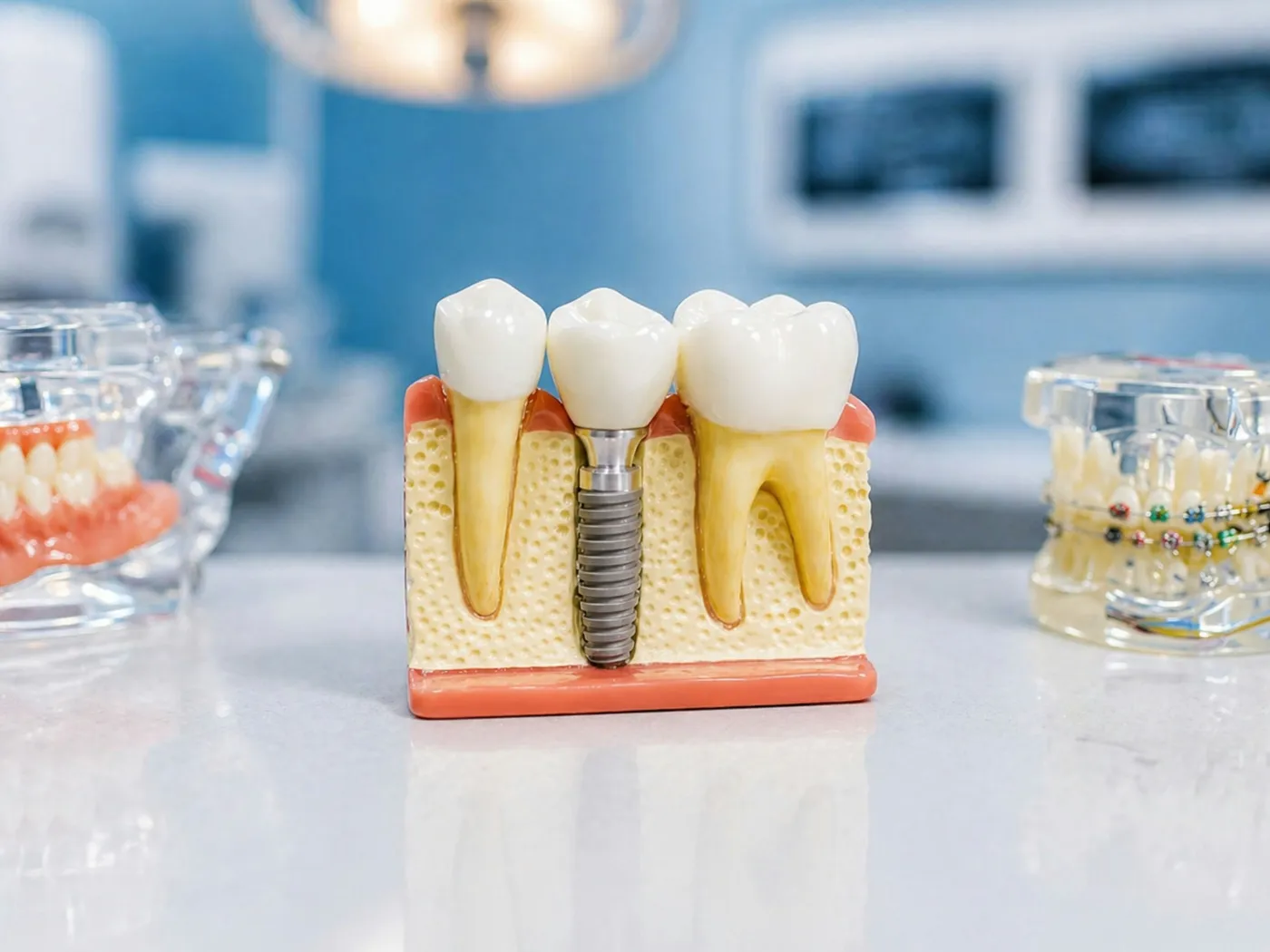
Modern implantology makes it possible to replace missing teeth by placing titanium implants into the maxillary or mandibular bone, which function as artificial roots.
On these implants, the following is then made a fixed prosthesis, which the patient does not have to remove.
This means that:
-
does not move during chewing
-
should not be taken off in the evening
-
cannot be lost
-
Is cleaned like natural teeth.
For many elderly patients, this is a radical change in the quality of life.
Implant solutions: All-on-Four and All-on-Six
Among the most advanced techniques for completely rehabilitating a dental arch are rehabilitations All-on-Four e All-on-Six.
These are implant-prosthetic solutions that allow the reconstruction of all the teeth in an arch using a limited number of implants.
All-on-Four
The Technique All-on-Four involves the insertion of four dental implants strategically placed in the bone.
A complete denture is fixed on these four implants, replacing all the teeth in the arch.
The main advantages are:
-
less invasive surgery
-
reduced time
-
possibility of avoiding bone grafts in many cases
-
Immediate stability of the prosthesis.
All-on-Six
The Solution All-on-Six uses instead six dental implants, distributing the chewing forces even more evenly.
This solution may be particularly suitable when:
-
the available bone allows it
-
a wider biomechanical distribution is desired
-
you want to further increase the stability of rehabilitation.
Both solutions provide an extremely stable and functional fixed prosthesis.
Fixed teeth quickly
One of the most important developments in modern implantology concerns the timing of rehabilitation.
Thanks to digital planning and protocols for immediate loading, in most cases it is possible to deliver a fixed provisional prosthesis within 24 hours of surgery.
This means that the patient:
-
Enters the office without teeth or with an unstable prosthesis
-
performs the implant surgery
-
returns home the next day with fixed teeth.
For many people this represents an immediate change in their quality of life.
Computer guided surgery: precision and safety
Today, implantology can be planned through sophisticated digital systems.
At Marano Dental Experience® we frequently use protocols of computer guided implant surgery, which allow us to:
-
plan the intervention three-dimensionally
-
Simulate the ideal location of plants
-
making precision surgical guides
-
Reduce the invasiveness of the intervention.
This approach often makes it possible to:
-
reduce surgical time
-
decrease postoperative discomfort
-
Increase the accuracy of treatment.
Implantology even in elderly patients
One of the most common myths is that dental implants are not indicated in elderly patients.
In fact. the age of registry is not a contraindication.
What matters is the overall health status of the patient.
Today, thanks to:
-
minimally invasive surgical techniques
-
digital planning
-
Conscious sedation with nitrous oxide
it is possible to deal with implant surgeries safely even in old age.
The Marano Dental Experience® approach
Each implant-prosthetic rehabilitation is designed as an individualized pathway.
Our goal is not only to replace missing teeth, but to to restore well-being, safety and quality of life.
For this we use:
-
three-dimensional digital planning
-
guided surgery when indicated
-
minimally invasive techniques
-
comfort protocols according to the Feather Method®
-
Conscious sedation with nitrous oxide for more anxious patients.
Conclusion
Tooth loss in old age should not be considered an inevitable fate.
Modern fixed implant-prosthetic rehabilitations, such as. All-on-Four e All-on-Six, today represent an extraordinary and transformative, capable of improvement:
-
nutrition
-
autonomy
-
confidence in speaking and smiling
-
quality of life.
For many elderly patients, it means getting back to living with serenity one of the most important moments of the day:
Sit at the table and eat without fear.
Learn more
Implantology in Rome
Replacing missing teeth with titanium implants: how the procedure is planned, what it involves and when it is chosen.
Go to the pageLooking for a dentist in Rome? Book an Appointment
Dr. Marano personally replies to every message he receives within 24 hours. Fill in the form and he will get back to you shortly.
Articoli Correlati
Stay in touch
One email when we publish something new. No promotions, nothing pointless.